
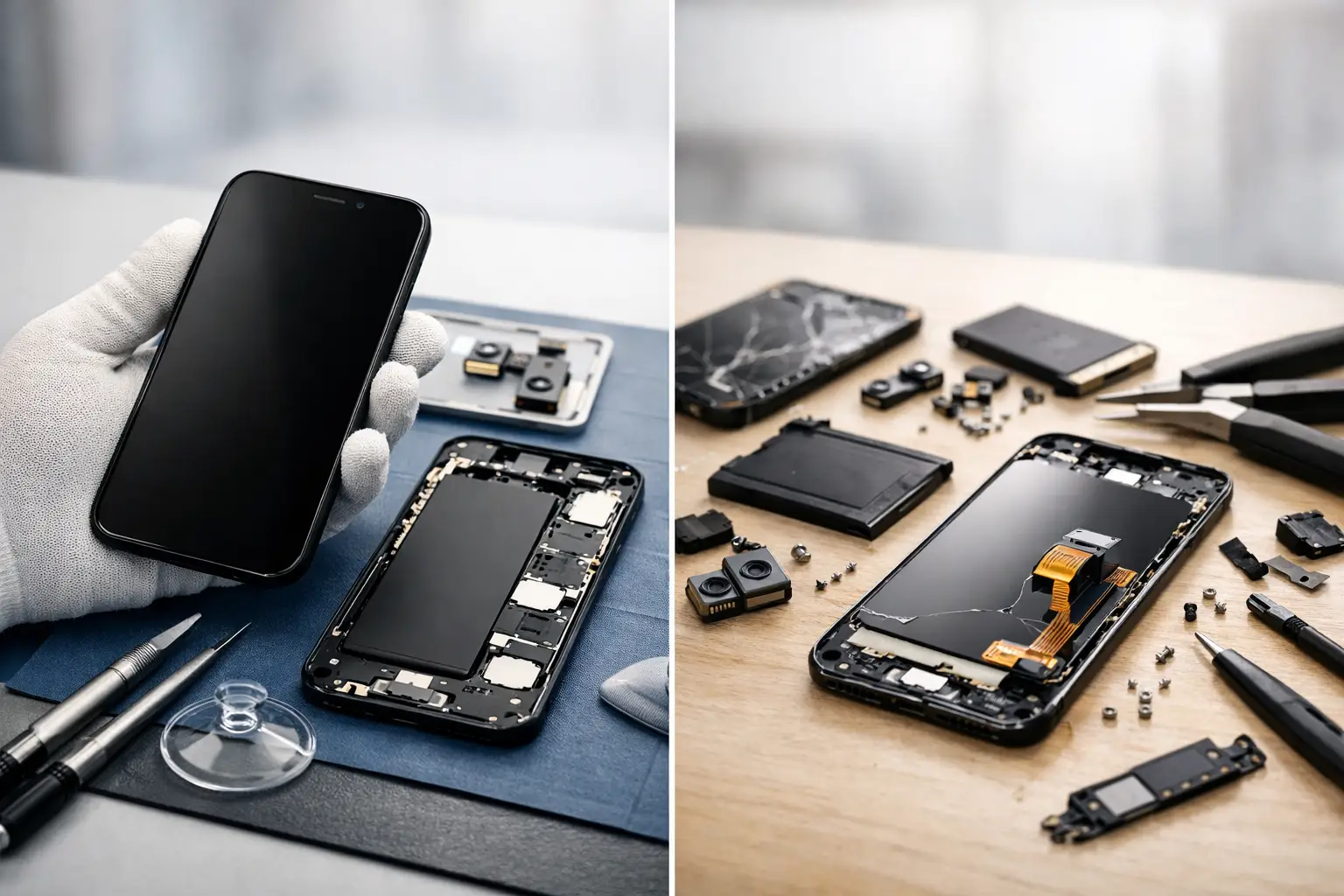
A screen replacement can look fine on the day and still turn into a headache a week later. That is usually where the real question starts – genuine parts versus aftermarket phone repair. Most people are not trying to become repair experts. They just want their phone working properly again, without poor battery life, odd touch response or a screen that looks wrong in daylight.
If you are choosing a repair in Portsmouth or Southsea, the part fitted matters just as much as the fitting itself. Two repairs can sound similar on price and turnaround time, but give very different results once you start using the phone every day. That is why it helps to understand what you are paying for and where the trade-offs are.
What genuine parts and aftermarket parts actually mean
Genuine parts are components made by, or for, the original manufacturer to that manufacturer’s specification. In simple terms, they are designed to match the phone as closely as possible in fit, function and performance.
Aftermarket parts are made by third-party manufacturers rather than the original brand. That does not automatically mean poor quality. Some aftermarket parts are decent and offer good value. Others are built to a lower standard, and that is where customers can run into problems.
The confusion comes from the fact that “aftermarket” covers a wide range. One screen might be perfectly usable, while another has weaker brightness, less accurate touch, poor colour balance or reduced durability. So the real conversation is not just genuine versus aftermarket in theory. It is about the quality of the specific part being fitted and whether the repairer is honest about it.
Genuine parts versus aftermarket phone repair – the main differences
The biggest difference most customers notice is consistency. Genuine parts are generally the closest match to the original phone experience. Screen brightness, colour, touch sensitivity, battery behaviour and overall fit are more likely to feel right.
With aftermarket parts, the result can still be good, but there is more variation. A well-sourced aftermarket screen may be a sensible option on an older device where keeping costs down matters. A cheaper low-grade part, on the other hand, can leave you with a phone that technically works but no longer feels quite right.
This is especially noticeable with iPhones. Customers often tell us they want the phone to feel normal again, not just partly repaired. That can mean proper brightness outdoors, smooth scrolling, reliable face recognition where relevant, and a screen that does not drain the battery faster than expected.
Price is where aftermarket parts usually appeal. They are often cheaper, and sometimes significantly so. For some people, that makes perfect sense. If the phone is older, used as a spare, or already close to replacement, paying less may be the smarter decision. The key is making that decision with clear information rather than finding out later why the repair was cheaper.
Screen quality is where most people notice the difference first
Screen repairs are the most common example because they are also the easiest place to spot quality differences. A genuine screen is more likely to match the original display for sharpness, brightness and touch response. It should also sit correctly in the frame and behave properly with the phone’s software.
An aftermarket screen can still restore a cracked phone quickly, but quality varies. Some common complaints with lower-grade screens include dim display brightness, touch lag, washed-out colours and reduced viewing angles. Customers may also notice the screen is more reflective, making it harder to use outside.
There is also durability to think about. A cheaper screen can save money up front but may be more prone to failure or damage again sooner. That does not mean every aftermarket screen is poor. It means the sourcing and standards of the repairer matter a great deal.
Batteries are not just about holding charge
Battery repairs raise similar issues, but the differences are sometimes less obvious at first. A genuine battery should be built to the correct specification for that model, including performance, safety and communication with the device.
With aftermarket batteries, the biggest risk is inconsistency. One may perform well, while another may lose health quickly, report inaccurate charge levels or struggle under heavier use. In some cases, people think the phone has another fault when the real problem is simply a lower-quality battery.
This is one of the reasons a clear warranty matters. A battery replacement is not just about getting the phone to switch on at 100 per cent. It is about whether the repair holds up over time and whether the repairer will put it right if it does not.
When aftermarket phone repair can still be the right choice
There are plenty of cases where aftermarket repair is a sensible option. If your phone is several years old, and the cost of genuine parts would feel out of proportion to the value of the device, a good-quality aftermarket part may be the best route.
It can also suit customers who simply need the phone functional again at a lower cost. For example, if a secondary device needs a screen replacement, or if you are planning to upgrade soon, paying for premium parts may not be necessary.
The important point is that aftermarket should be a conscious choice, not a hidden downgrade. A reliable repairer should tell you what type of part is being used, explain the likely difference in performance, and let you decide based on your budget and priorities.
When genuine parts are usually worth paying for
If you rely heavily on your phone for work, travel, banking, study or daily communication, genuine parts are often worth stronger consideration. The more you use the device, the more likely you are to notice small differences in screen response, battery behaviour or overall reliability.
They also make more sense on newer or higher-value phones. If you have spent a significant amount on the device, using parts that preserve its original performance can be the better long-term choice.
For many customers, the real value is confidence. They do not want to second-guess the repair every time the screen looks slightly off or the battery drops too quickly. They want the phone back in service, working as it should, with proper support behind it.
Why the repairer matters as much as the part
A good part fitted badly can still cause problems. Equally, an honest repairer using high-quality aftermarket components may give a better result than a poor repairer offering vague promises about “premium” parts.
That is why transparency matters. You should know what part is being fitted, what standard it is, what warranty comes with it, and who you speak to if anything is not right afterwards. Local repair services have a real advantage here because accountability is clear. You are not dealing with a call centre or sending your device away to an unknown bench technician.
At iHelp Gadget Repairs, that direct approach matters. Customers speak to the person doing the work, get clear advice on part options, and know where they stand on warranty and turnaround time. That removes a lot of the uncertainty that often surrounds phone repairs.
Questions worth asking before you book
If you are comparing quotes, ask whether the part is genuine or aftermarket, and if aftermarket, what level of quality it is. Ask how the screen or battery is expected to perform compared with the original. Ask what warranty is included and whether any features may be affected.
It is also worth asking how quickly the repair can be done and whether diagnostics are included if the issue turns out to be more than a broken screen or tired battery. A very cheap quote can look attractive until it excludes testing, warranty support or proper aftercare.
A trustworthy repairer will not dodge these questions. They will answer them plainly and help you choose the option that fits your phone, your budget and how you use the device.
The right repair is the one that matches your priorities
There is no one-size-fits-all answer to genuine parts versus aftermarket phone repair. Some customers want the closest possible match to the original device and are happy to pay for that. Others want a reliable, cost-effective repair on an older handset and do not need top-tier parts.
What matters is knowing the difference before the repair starts. A phone repair should not feel like a gamble. When the advice is clear, the pricing is transparent and the warranty is solid, it is much easier to choose with confidence.
If your phone is part of your everyday routine, the cheapest quote is not always the cheapest outcome. A well-chosen repair should leave you with a device you can trust again, and that is usually worth more than saving a few pounds on the day.