
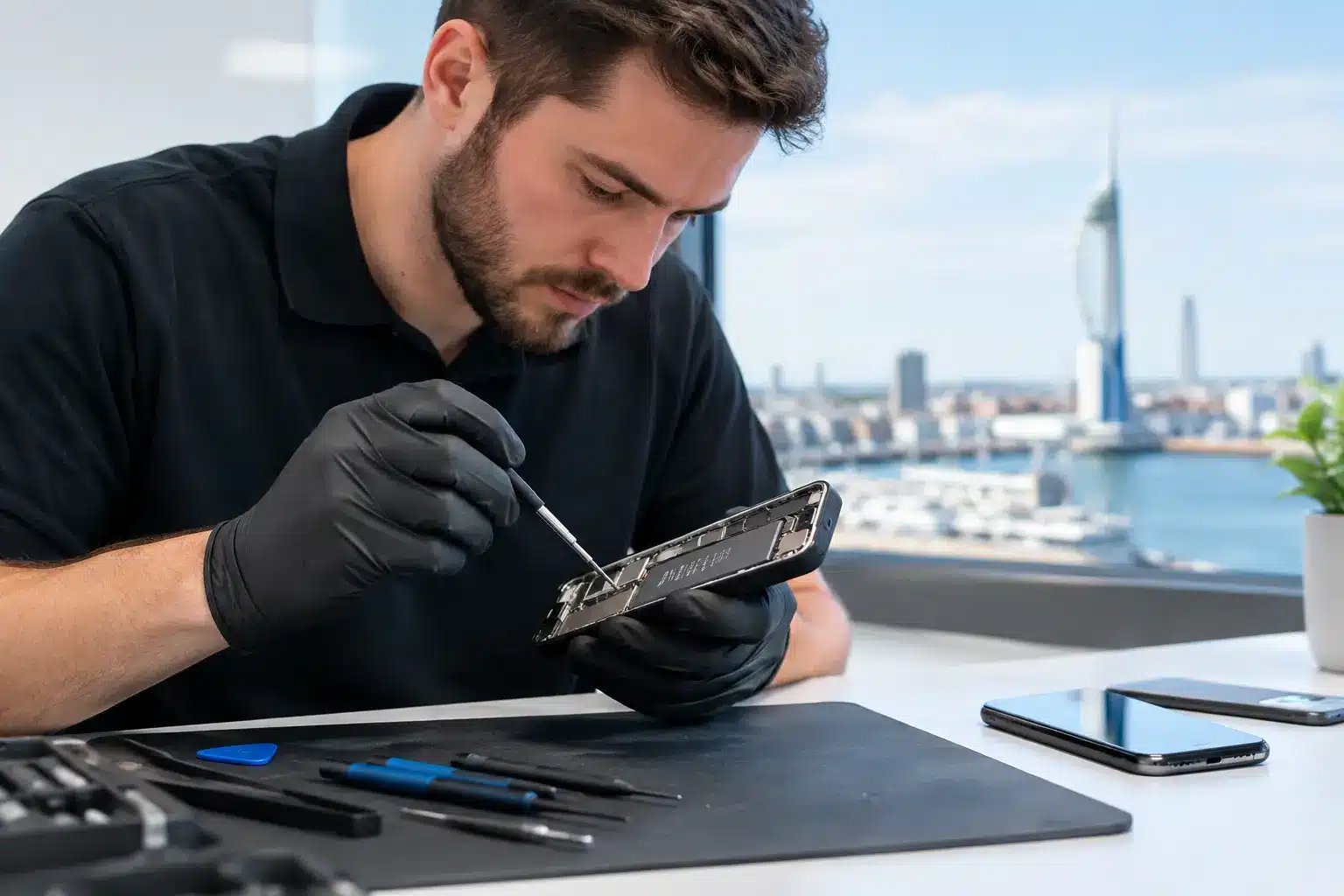
Your phone can look perfectly fine while failing at the one job you need it to do. It may charge only at a certain angle, lose battery faster than usual, drop calls, overheat, or refuse to recognise your SIM. The best phone diagnostic services do more than identify the obvious symptom. They find the cause, explain it clearly and give you an honest route forward before any repair begins.
For people in Southsea and Portsmouth, that matters. A phone is often your work diary, travel pass, banking app, camera, family contact and study tool all at once. Guessing at the fault can waste time and money. A proper diagnostic check helps you decide whether a repair is sensible, how urgently it is needed and what the likely cost will be.
What the best phone diagnostic services should check
A useful diagnostic is not simply plugging a device into a cable and seeing whether it switches on. It is a structured process that looks at how the phone behaves, what has happened to it and which component is most likely responsible.
The technician should start by listening. A phone that stopped charging after getting wet needs investigating differently from one that charges intermittently after months in a dusty pocket. Equally, a screen that flickers after a drop may be a damaged display, but it could also point to a connector or internal board issue. The history of the fault is part of the diagnosis.
From there, a thorough check can cover battery health and power draw, charging port condition, charging cable response, display and touch function, cameras, speakers, microphones, buttons, Wi‑Fi, Bluetooth, mobile signal and proximity sensors. On suitable devices, software checks can also reveal error messages, repeated restarts or signs that the operating system is contributing to the problem.
Not every fault needs every test. The right approach depends on the device and its symptoms. What matters is that the checks are relevant, the findings are explained in plain English and you are not pressured into a repair before you understand the issue.
The difference between a symptom and a fault
A weak battery is a good example. If a phone shuts down at 30 per cent, the battery may well be worn. But a failing charging port, water damage, a poor-quality replacement part or a software problem can create similar complaints. Replacing the battery without checking the wider picture may not solve it.
The same applies to “no charging” faults. Lint packed into the port can prevent a cable from seating properly, while a damaged port may need repair. In more serious cases, the problem sits further inside the phone. A good diagnostic service separates these possibilities before recommending work.
When to book a phone diagnostic
Some problems are clear enough to price quickly. A visibly cracked iPhone screen or a snapped charging connector often has an obvious repair route. Other faults deserve a diagnostic first, especially when the device has more than one symptom or the cause is uncertain.
Book a check if your phone turns on and off by itself, gets hot when it is not being used, will not charge consistently, loses signal, has stopped recognising Face ID or fingerprint security, or has been exposed to liquid. It is also worth bringing in a device that has become unusually slow after an update, particularly if storage is not the issue.
A diagnostic is sensible after a hard drop even where there is no visible damage. Internal connectors can work loose and parts can fail later. Catching the problem early may prevent a small repair becoming a larger one.
If your phone is swollen, the screen is lifting away from the frame, or there is a burning smell, stop using it and do not attempt to charge it. These can be warning signs of a damaged battery. Keep the device away from heat and arrange professional advice as soon as possible.
What a fair diagnostic process looks like
Trust usually comes down to what happens before the repair, not just after it. You should know what is being tested, whether there is a diagnostic charge, what the likely repair involves and whether the price could change if further damage is found.
A local specialist should also be open about the limits of a diagnostic. Some faults only become fully clear once a device is opened, particularly after liquid damage or a heavy impact. That is not a reason for vague pricing. It is a reason to explain the uncertainty upfront and ask for approval before moving beyond the initial assessment.
The best repairers do not treat a diagnostic as a sales pitch. Sometimes the honest answer is that repair is not economical. This can happen with severe board damage, an older handset with several failing components, or a phone whose repair cost is close to the price of a reliable replacement. A clear recommendation, even when it is not the answer you hoped for, is far more useful than spending money on a short-term fix.
Questions worth asking before you hand over your phone
Before booking, ask who will carry out the assessment and whether you can speak directly to that person. Find out how long the diagnostic is likely to take, whether your data could be affected, and whether any repair work starts without your approval.
It is also reasonable to ask about replacement-part quality and warranty cover. A warranty is not just a line on a receipt. It shows that the repairer is prepared to stand behind their workmanship and the parts fitted. Check what is covered, how long for and what happens if the original fault returns.
For devices containing work files, photographs or personal information, ask about privacy too. A technician may need your passcode to test certain functions, but should explain why. Back up your device where possible, remove any sensitive accounts you can, and use a temporary passcode if that gives you greater peace of mind.
Local diagnosis versus sending your phone away
Mail-in repairs can suit simple jobs if price is your only priority. The trade-off is time and distance. You may be without your phone for days, you cannot easily show the fault happening in front of the technician, and updates can pass through a customer service team rather than the person doing the work.
A local diagnostic gives you the chance to describe the problem directly. If your phone only loses charge on the way to work, or the speaker crackles during calls but not music, those details help narrow down the cause. You can also ask questions face to face and make a decision once the findings are clear.
At iHelp Gadget Repairs, customers deal directly with Dan from first enquiry through to repair completion. That owner-led approach is particularly useful for faults that need careful testing rather than a one-size-fits-all replacement. With more than 20 years of experience, the focus is on identifying the genuine issue and offering a practical repair option, not adding unnecessary work.
For straightforward iPhone screen repairs, speed matters too. Many can be completed in under 30 minutes, with a lifetime warranty on iPhone screens and a 12-month warranty on other eligible repairs. However, a quick turnaround should never mean skipping diagnosis when the fault is unclear. A phone with a new screen can still have hidden charging, battery or water-damage issues that need attention.
How to prepare your phone for a diagnostic check
A little preparation can make the appointment smoother and protect your information. Charge the phone if it will accept power, bring the cable or charger you normally use if charging is the issue, and make a note of when the fault started. Mention recent drops, water exposure, repairs or software updates, even if they seem unrelated.
If you can, back up the device before bringing it in. This is especially important where the phone is restarting, has storage problems or may require more involved repair. Do not delay an urgent battery or liquid-damage assessment just to complete a backup, though. Safety comes first.
Try not to rely on online fault codes alone. They can be useful clues, but they rarely tell the full story. Two phones can show the same message for different reasons, and a repair based on a guess can cost more than a proper assessment.
Choose clarity over guesswork
The right diagnostic service should leave you better informed, whether you choose to repair the phone or not. You should understand what has failed, why the suggested repair is appropriate, what it will cost and how the work is protected.
When a device is part of every working day, getting answers quickly is valuable. Speak to a local technician, explain what your phone is doing and ask for a clear assessment before committing to a repair. That simple step can save you from replacing the wrong part, losing more time without your device or giving up on a phone that still has plenty of life left.