
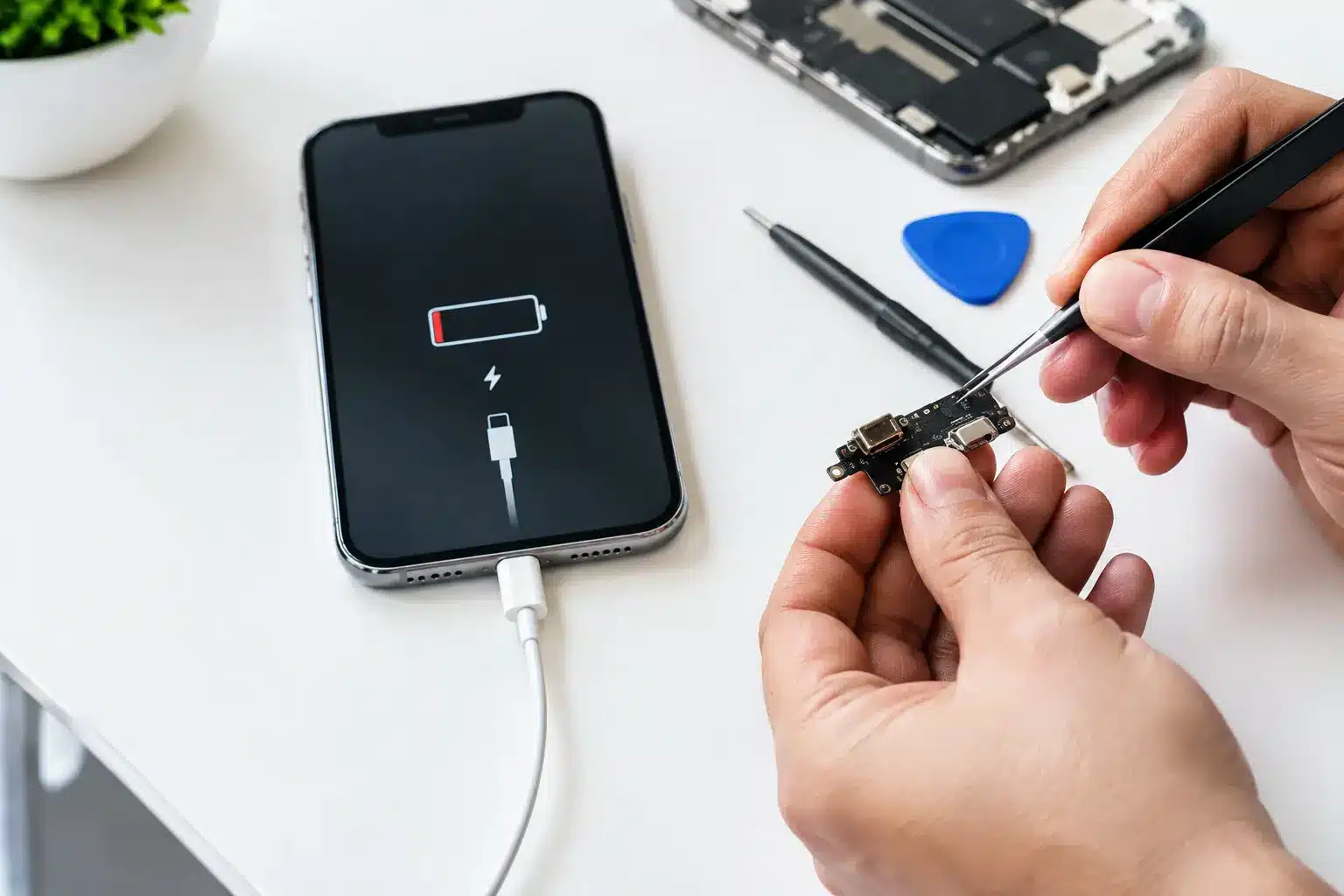
A phone that only charges at a certain angle can turn a normal day into a nuisance very quickly. This iPhone charging fault repair example shows why a loose connection is not always a simple charging-port replacement, and why a proper diagnosis can save time and unnecessary cost.
For someone travelling between lectures, shifts, school runs or work across Portsmouth and Southsea, a phone with an unreliable charge is more than an inconvenience. Battery percentage becomes something to manage rather than trust. The right repair starts by finding the actual cause, not by replacing parts on a guess.
An iPhone charging fault repair example from diagnosis to repair
A customer brings in an iPhone that has stopped charging consistently. Their cable works in another device, but on this phone it needs to be pushed firmly into the port and held at a particular angle. Sometimes the charging symbol appears, then disappears. Wireless charging may still work, but that is not a complete solution for a phone used every day.
At first glance, this can look like a damaged charging port. That is possible, but it is not the only explanation. Pocket lint can become tightly compacted at the back of the connector, preventing the cable from seating fully. A worn or damaged cable can give the same symptoms. There could also be damage to the charging assembly, a battery issue, liquid exposure, corrosion or, less commonly, a fault elsewhere on the board.
The sensible first step is to inspect the port and test the phone with known-good charging equipment. The cable should click securely into place. If it feels loose, sits proud of the bottom of the port or cuts in and out with the slightest movement, that gives the technician useful evidence. Testing power draw and charging behaviour helps narrow down whether the phone is accepting charge as it should.
In this example, the port contains compacted debris. It is cleaned carefully using suitable tools under magnification, then retested with a known-good cable and charger. The connector now seats properly and the phone charges steadily. No replacement part is needed.
That is a good outcome, but it also illustrates the value of diagnosis. Replacing a charging port before checking for debris would have added cost and opened the device unnecessarily. Honest repair work means recommending the repair the phone needs, rather than the most expensive one.
When cleaning is not enough
Now consider a slightly different result. The port is clean, but the cable still moves around, charging remains intermittent and the phone does not draw power reliably. In that case, wear or damage to the charging port assembly becomes more likely.
The repair then involves opening the iPhone, disconnecting the battery safely, removing the affected charging assembly and fitting a high-quality replacement part. The phone is reassembled and tested for stable cable charging, microphone function and other features connected to that assembly. A charging fault repair should not stop at seeing the battery icon appear once. It needs to hold a reliable connection and perform properly after testing.
On many iPhone models, the charging assembly is integrated with other components. That is why the quoted work can vary by model. An older iPhone may be relatively straightforward, while a newer model may require more careful access and additional testing. Anyone promising one fixed price for every iPhone before checking the model and fault is often simplifying a job that depends on the device in front of them.
What can look like a charging port fault?
A charging issue has several possible causes, and the symptoms matter. A phone that only charges at an angle is more likely to have a blocked, worn or damaged port. A phone that shows it is charging but loses battery percentage may have a battery health issue, excessive power use, or a charging source that is not delivering enough power.
If the iPhone will not charge by cable but works on a wireless pad, the cable port deserves close inspection. If it will not charge by cable or wirelessly, the diagnosis needs to be broader. A software problem can occasionally affect charging behaviour, but repeated physical connection problems should not be dismissed as software without checks.
Liquid exposure also changes the picture. Even if an iPhone appears to work after getting wet, corrosion can develop over time. The fault may begin as occasional charging, then become a complete failure days or weeks later. In these cases, cleaning the visible port alone may not resolve the underlying issue. A clear explanation of what has been found, the likely repair route and any risk is more useful than a rushed promise.
Checks to make before booking a repair
There are a few safe checks worth making before assuming the phone needs a new part. Try a different certified or good-quality cable and charging plug. Inspect the cable end for damage, and remove any obvious loose fluff from around the port opening without forcing objects inside.
Avoid using pins, paper clips or sharp metal tools in the connector. It is easy to damage the internal contacts, push debris deeper or create a fault where there was only a blockage. Do not keep bending the cable upward or downward to make it work either. That pressure can worsen damage to the port and cable.
It also helps to notice the exact pattern. Does the iPhone charge from a computer but not a mains plug? Does it work with one cable only? Does it become hot while charging? Does it show a liquid-detection warning? Those details help make diagnosis quicker and more accurate when you bring it in.
If the phone has important photos, messages or work files, back it up when possible before any repair. Most charging-port work does not affect data, but a backup is always sensible when a device is already showing signs of hardware trouble.
What a good charging repair should include
The repair itself matters, but so does how it is handled. You should know what is being checked, whether cleaning or replacement is required, what the price covers and how long the work is expected to take. A local repair specialist should be comfortable explaining the difference in plain English.
At iHelp Gadget Repairs, customers deal directly with Dan from the initial enquiry through to the completed repair. That matters when the fault is intermittent or has a history. You are not repeating the same details to a call centre, a counter assistant and then an unseen technician.
Many iPhone repairs can be completed quickly, often in under 30 minutes where the model and repair allow it. Charging faults are different because a proper diagnosis must come first. If a port clean resolves the issue, it may be a short visit. If the phone needs a replacement charging assembly, has liquid damage or requires further fault-finding, the timescale depends on the model and what testing reveals.
Quality parts and careful fitting are worth asking about. A low-cost repair that introduces microphone problems, poor connection or another fault is not good value. Warranty-backed work gives further reassurance, although the terms should always match the repair carried out and the condition of the device.
When repair is the right choice
A charging fault does not automatically mean replacing the phone. If the iPhone is otherwise in good condition, a clean, port repair or battery replacement can extend its useful life at a fraction of the cost of upgrading. This is particularly sensible when the screen, cameras and overall performance are still meeting your needs.
There are exceptions. A phone with extensive liquid damage, repeated board-level faults and a badly degraded battery may need a more detailed conversation about cost versus value. The right answer depends on the model, its condition and how reliable you need it to be. Straightforward advice is more valuable than being pushed towards a repair that does not make financial sense.
If your iPhone is charging only when the cable is held in place, do not wait for it to stop altogether. Bring it in while the symptoms are still clear, keep hold of the cable you normally use, and describe exactly what happens. A careful inspection can turn an unreliable daily annoyance into a repair with a clear, practical answer.