
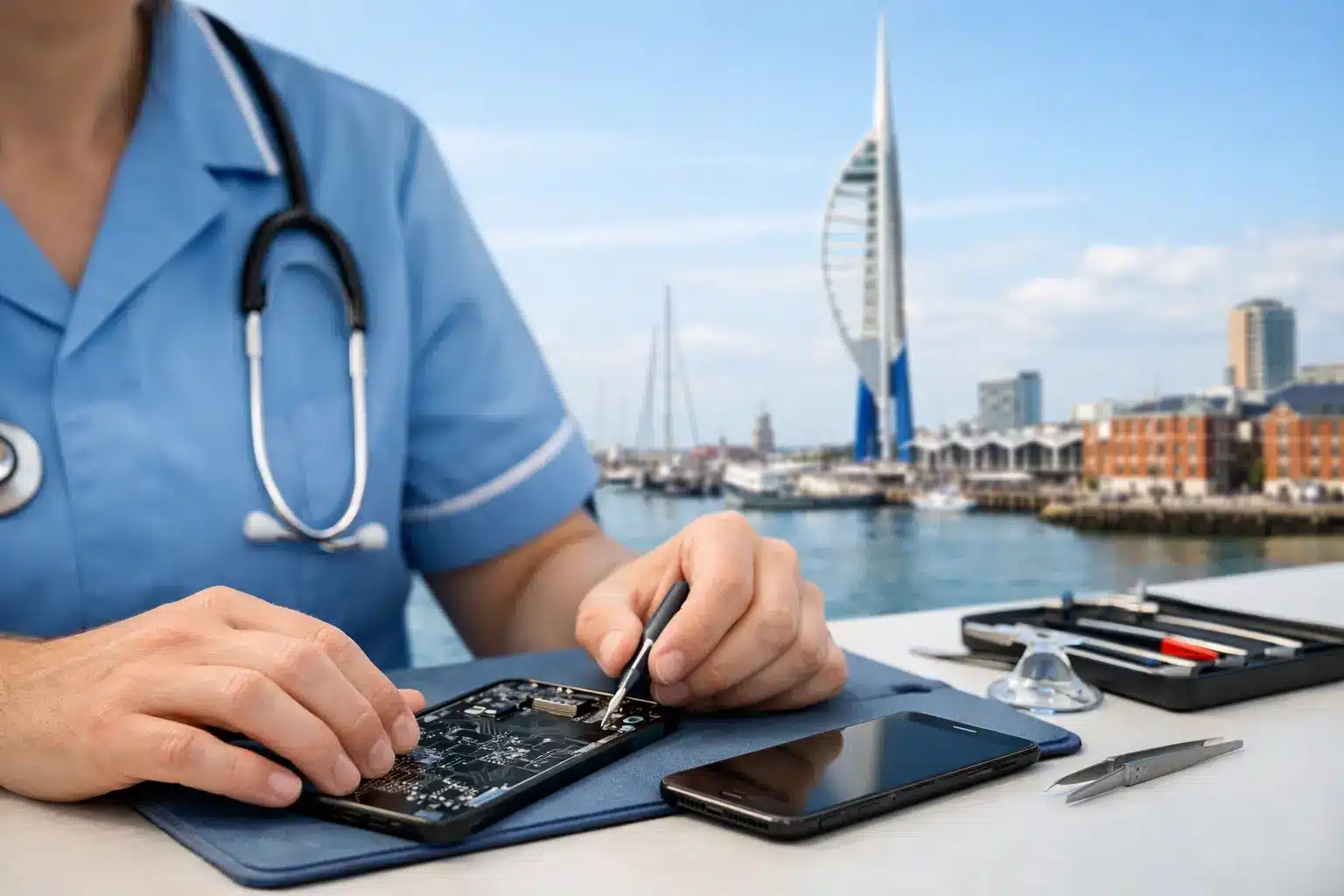
A cracked screen or failing charging port rarely happens at a convenient time. For NHS staff working long shifts, a phone is often the link to family, rota updates, transport, banking and everything else that needs sorting between shifts. If you are looking for NHS discount phone repair in Portsmouth, the saving matters, but so does knowing the repair will be done properly, quickly and with clear accountability.
A low headline price is only useful when it includes quality parts, a proper fitting service and a warranty worth having. Before handing over a device, it pays to understand what a local repair specialist is offering and what to ask.
What NHS discount phone repair should include
An NHS discount should be straightforward. You should be told which repairs qualify, what proof of eligibility is needed and whether the discount applies to parts, labour or the total bill. It is reasonable to ask whether the offer is available for screen replacements, batteries, charging faults and other common repairs, rather than assuming every repair is covered.
The final price should also be clear before work begins wherever possible. Some faults, particularly liquid damage, board-level issues or devices with more than one fault, need diagnosis before an exact quote can be given. That is not a problem in itself. The important point is that the technician explains the findings and gets your approval before carrying out additional work.
For many people, the real value is not simply a percentage off. It is avoiding a second repair because a cheap part has failed, a screen has poor touch response or a charging issue has been treated as a quick clean when the port actually needs replacing.
Speed matters when your phone supports your shift
Being without a phone for several days can cause more disruption than the cost of the repair. That is why turnaround time deserves the same attention as the discount. A local repair shop may be able to complete a common iPhone screen repair while you wait, often in under 30 minutes, depending on the model and part availability.
Not every job should be rushed. A phone that will not charge could have lint in the port, a worn battery, a damaged charging connector or a deeper fault. A good technician will diagnose the cause instead of replacing parts by guesswork. That approach can take longer for complex issues, but it prevents you from paying for the wrong repair.
If you need your device back around a shift, ask when it can be booked in, how long the repair is likely to take and whether there are any parts to order. Clear answers make planning much easier than sending a phone away and waiting for a status update.
Common repairs worth asking about
Screen damage is the most obvious reason people seek a repair, but it is far from the only one. NHS staff and other busy local customers often need help with battery replacements, charging faults, damaged rear glass, cameras, microphones, speakers and tablet or MacBook issues.
A battery that drains quickly may be worn out, especially if the phone is several years old. Replacing it can be a sensible alternative to upgrading, provided the rest of the device is in good condition. Equally, a phone that only charges at a certain angle may need a proper port repair rather than a new cable bought in frustration.
For iPhones, ask what type of screen is being fitted and what warranty comes with it. There can be a difference between a basic compatible display, a high-quality replacement and a genuine part. The right choice depends on your model, budget and how you use your phone, but the differences should be explained in plain English.
Check the warranty, not just the repair price
A warranty is one of the clearest signs that a repairer stands behind their work. It should cover the part and the fitting, with terms that are easy to understand. It will not usually cover a fresh drop, liquid damage or unrelated faults, but it should give you confidence if the replaced component develops a fault through normal use.
Be cautious if a repair is unusually cheap but has little or no warranty. The initial saving can disappear quickly if the screen develops lines, loses touch sensitivity or the battery performs poorly a few weeks later. A transparent repairer will explain what is covered without hiding behind vague wording.
At iHelp Gadget Repairs, customers deal directly with Dan from the first enquiry through to collection. That matters when you need a clear answer about your device, rather than being passed between a counter, a call centre and an off-site technician. With more than 20 years of experience and warranty-backed repairs, the focus is on getting the fault fixed properly and making sure you know where to return if you need support afterwards.
Choose local accountability over a faceless process
Mail-in repair services can look convenient, but they are not always the best option when a device is essential. You need to package the phone, send it away, wait for an assessment and hope the final quote matches the initial estimate. If anything changes, the process can become slower still.
A local Portsmouth repair specialist gives you the chance to speak to the person handling the device. You can show them the fault, discuss the repair options and ask questions before agreeing to anything. For a cracked screen, that may mean a quick repair and collection on the same day. For a more complicated fault, it means receiving an honest assessment rather than a generic update.
Local reviews are useful here, especially when they mention communication, turnaround time and how problems were resolved. A long list of five-star ratings is encouraging, but the detail matters more. Look for evidence that customers felt informed, treated fairly and supported after the repair.
Prepare your phone before bringing it in
A few minutes of preparation can protect your information and help the repair go more smoothly. Back up your device if it still works, either to cloud storage or a computer. Remove any payment cards or sensitive items from a digital wallet if you prefer, and make sure you know your passcode.
In many cases, a technician may need the passcode to test the screen, cameras, speakers, charging and other functions after repair. You should only provide it if you are comfortable doing so, and a reputable repairer should explain why access is needed. Activation Lock or Find My may also need to be turned off for certain work, particularly where parts or diagnostics require it.
Do not delay a repair if the screen is lifting, the battery is swelling or there is exposed glass. A swollen battery can place pressure on the display and may become a safety concern. Switch the device off where possible and arrange an assessment rather than continuing to charge or use it heavily.
Ask the right questions before booking
You do not need technical knowledge to make a good decision. Ask for the total expected cost, the type of part being used, the likely turnaround and the warranty terms. If you are claiming an NHS discount, confirm what identification is required and whether it is applied before payment.
It is also worth asking whether the repair could affect features such as Face ID, fingerprint recognition, water resistance or display warnings. The honest answer will vary by device and fault. Modern phones are tightly built, and no repairer should promise that a phone will remain factory water-resistant after it has been opened. What they can promise is careful workmanship, suitable parts and clear advice about the limitations.
The best NHS discount phone repair is not simply the one with the lowest number on the receipt. It is the repair that gets a device you rely on back in your hands quickly, uses parts you can trust and comes with someone local who will stand behind the work.